

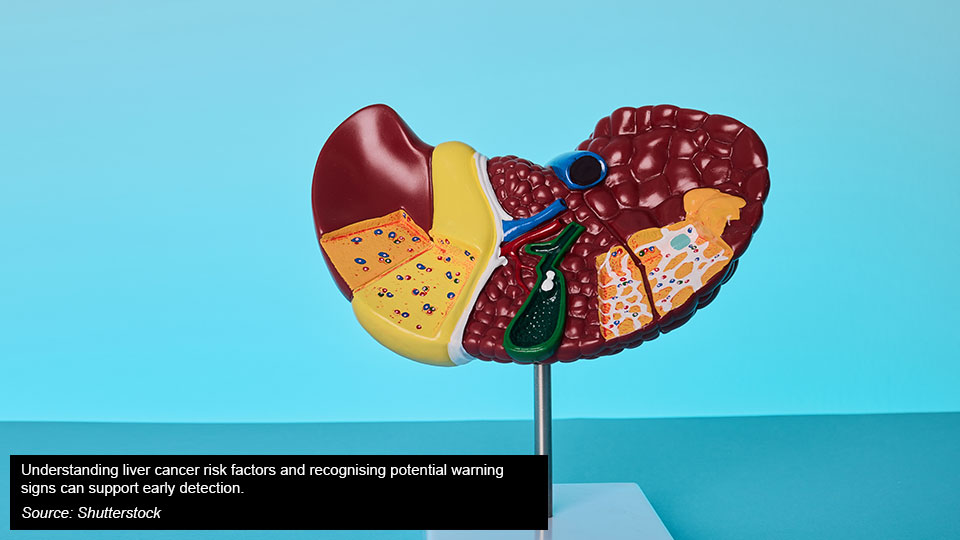
Liver Cancer: Symptoms, Causes, Stages and Survival Rates
At a Glance
Liver cancer can develop without noticeable symptoms in its early stages. In this article, you will learn about the warning signs, common risk factors and available screening options, including the GAAD Profile. Discover how early detection and appropriate surveillance may help individuals at increased risk take a proactive approach to their liver health.
The liver plays an essential role in keeping the body healthy. It processes nutrients, produces bile to aid digestion, stores energy and helps remove harmful substances from the blood. However, liver diseases can develop without obvious symptoms, making it important to understand the risks and recognise potential warning signs.
Liver cancer occurs when abnormal cells in the liver grow uncontrollably. Although it can be a serious condition, understanding its symptoms, causes and risk factors can help individuals seek medical attention and appropriate screening when needed.
What is liver cancer?
Liver cancer develops when abnormal cells grow and multiply uncontrollably in the liver, forming a tumour. There are two main categories:
Primary liver cancer
Cancer that originates in the liver. The most common type is hepatocellular carcinoma (HCC), which develops from hepatocytes, the main cells of the liver.
Secondary liver cancer
Cancer that spreads to the liver from another part of the body, such as the colon, breast or lungs. This is also known as metastatic liver cancer.
Understanding the type of liver cancer is important because the investigations and treatment options may differ.
What are the symptoms of liver cancer?
Liver cancer may not cause noticeable symptoms in its early stages. Some people discover the condition during investigations for another health concern or through regular surveillance because they have an increased risk of developing liver cancer.
As the disease progresses, symptoms may become more apparent. Common liver cancer symptoms include:
Upper abdominal pain or discomfort
Pain may occur on the right side of the upper abdomen, where the liver is located.
Abdominal swelling
The abdomen may become enlarged due to fluid accumulation or changes associated with an enlarged liver.
Unexplained weight loss
Losing weight without changes to diet or physical activity may be a warning sign.
Loss of appetite
Some people may eat less than usual or feel full quickly after a small meal.
Nausea and vomiting
Persistent nausea or vomiting may occur as the disease progresses.
Jaundice
Yellowing of the skin and whites of the eyes may develop when the liver cannot process bilirubin effectively.
Persistent fatigue or weakness
Unusual tiredness that does not improve with adequate rest may accompany liver disease.
Itchy skin
Changes in bile flow may cause persistent itching.
Easy bruising or bleeding
Impaired liver function may affect the production of proteins needed for blood clotting.
These symptoms are not exclusive to liver cancer and may be caused by other medical conditions. However, persistent, unexplained or worsening symptoms should be assessed by a doctor.
What is the first sign of liver cancer?
There is no single first sign of liver cancer. In fact, some people experience no noticeable symptoms in the early stages.
When symptoms do occur, they may include vague discomfort in the upper abdomen, reduced appetite, unexplained weight loss or persistent fatigue. These symptoms can be mistaken for common digestive problems or general tiredness.
For individuals with chronic liver disease, the first indication of a problem may instead be an abnormal blood test or a finding on an imaging scan performed as part of routine surveillance.
This is why people with known risk factors should not rely on symptoms alone to determine whether their liver is healthy. Discussing an appropriate monitoring plan with a doctor can help identify changes that warrant further investigation.
What causes liver cancer?
| Risk factor | How it increases liver cancer risk |
|---|---|
| Chronic hepatitis B infection | Long-term infection with the hepatitis B virus increases the risk of HCC. Liver cancer can develop in some people with chronic hepatitis B even without cirrhosis. |
| Chronic hepatitis C infection | Hepatitis C can cause persistent inflammation and damage to the liver. Over time, this may lead to cirrhosis and increase the risk of liver cancer. |
| Liver cirrhosis | Cirrhosis occurs when prolonged liver damage causes healthy tissue to be replaced by scar tissue. It can result from chronic viral hepatitis, alcohol-related liver disease, metabolic dysfunction-associated steatotic liver disease and other chronic liver conditions. |
| Metabolic dysfunction-associated steatotic liver disease (MASLD) | MASLD, previously known as non-alcoholic fatty liver disease (NAFLD), involves excess fat accumulation in the liver associated with metabolic risk factors. In some individuals, it can progress to inflammation, scarring and cirrhosis, increasing the risk of liver cancer.
While most patients with MASLD-related liver cancer have cirrhosis, 30% develop liver cancer without cirrhosis. |
| Excessive alcohol consumption | Long-term excessive alcohol intake can damage liver cells, cause cirrhosis and increase the risk of liver cancer. |
Other factors, including smoking, certain inherited conditions and exposure to aflatoxins, which are toxins produced by some types of mould that can contaminate food, may also contribute to risk.
Having one or more risk factors does not mean that a person will develop liver cancer. Conversely, liver cancer can occasionally occur in people without recognised risk factors.
What is hepatocellular carcinoma (HCC)?
Hepatocellular carcinoma (HCC) is the most common type of primary liver cancer. It develops in hepatocytes and is often associated with chronic liver disease.
Chronic hepatitis B infection and liver cirrhosis are major risk factors for HCC. Other contributing factors include chronic hepatitis C infection, alcohol-related liver disease and MASLD.
HCC may not cause noticeable symptoms in its early stages. As the disease progresses, symptoms may include upper abdominal discomfort, unexplained weight loss, loss of appetite, abdominal swelling and jaundice.
Because early HCC can be difficult to detect through symptoms alone, appropriate surveillance is important for individuals at increased risk. Regular medical follow-up can help identify suspicious changes that require further assessment.
How can screening help detect liver cancer?
Liver cancer may develop without obvious early warning signs. For individuals at increased risk, appropriate surveillance can help identify suspicious changes before symptoms become apparent.
Depending on a person’s medical history and risk factors, a doctor may recommend liver ultrasound and blood tests, including alpha-fetoprotein (AFP). AFP is a protein that may be elevated in some people with HCC, but it cannot diagnose liver cancer on its own.
Raffles Medical Group offers the GAAD Profile screening service as an option for individuals looking to take a proactive approach to liver cancer screening.
The suitability of screening depends on individual risk factors and clinical circumstances. People with chronic hepatitis B, liver cirrhosis or a family history of HCC should discuss an appropriate surveillance plan with their doctor.
Screening results should be interpreted alongside medical history and other clinical findings. An abnormal result does not necessarily mean that cancer is present, while a normal result cannot completely exclude liver cancer. Further investigations may be needed if there are concerning findings.
| Comparison | GAAD test | Conventional tumour marker tests |
|---|---|---|
| What it measures | Combines age, sex and two blood markers, alpha-fetoprotein (AFP) and des-gamma-carboxy prothrombin (DCP), into a single score. | Measures individual blood markers, such as AFP or DCP, which may be elevated in people with liver cancer. |
| How results are assessed | Uses a combined score to estimate the likelihood of hepatocellular carcinoma (HCC), the most common type of primary liver cancer. | Individual marker levels are interpreted alongside a person’s risk factors and other clinical findings. |
| What it helps to identify | Individuals with a higher likelihood of HCC by combining information from two tumour markers with age and sex. | Abnormal tumour marker levels that warrant further clinical assessment. |
| Who may benefit | People who require assessment for liver cancer, particularly those with chronic liver disease or other relevant risk factors, as advised by their doctor. | People at increased risk of liver cancer who require surveillance or further clinical assessment, as advised by their doctor. |
| Key advantage | Combines multiple parameters into one score, potentially improving detection performance over individual markers. | Offers straightforward measurement of individual biomarkers, but each marker has its own diagnostic limitations. |
| Clinical use | Provides an additional tool to support HCC risk assessment and clinical decision-making. | Provides useful biomarker information for HCC surveillance and clinical assessment. |
What you should know about liver cancer screening
Liver cancer may not cause noticeable symptoms in its early stages. Screening and surveillance may help identify suspicious changes in people at increased risk.
The GAAD Profile combines multiple factors to support HCC risk assessment, but no single blood test can confirm or completely rule out liver cancer. Speak to your doctor about which tests and surveillance approach are appropriate for you.
How is liver cancer diagnosed?
If liver cancer is suspected, a doctor may recommend investigations to evaluate the liver and determine whether cancer is present.
These may include:
- Blood tests: Liver function tests provide information about liver health. AFP may also be measured as part of the assessment.
- Imaging scans: Ultrasound, computed tomography (CT) or magnetic resonance imaging (MRI) can help identify suspicious liver lesions and assess their size and location.
- Liver biopsy: In selected cases, a small tissue sample may be taken for examination under a microscope. A biopsy is not always necessary, as certain imaging findings may be sufficient to establish a diagnosis in the appropriate clinical setting.
If cancer is confirmed, further investigations may determine its stage and whether it has spread beyond the liver. These findings help guide treatment decisions.
What are the stages of liver cancer?
Liver cancer staging describes the extent of the disease and helps doctors determine the most appropriate treatment. The exact staging system used may vary according to the clinical context.
Broadly, liver cancer may be described as:
Early-stage liver cancer
The tumour is limited and may be suitable for treatment with curative intent, such as surgical removal, ablation or liver transplantation in selected patients.
Intermediate-stage liver cancer
There may be multiple tumours within the liver, but the disease has not necessarily spread to distant organs. Treatments targeting the tumours and their blood supply may be considered.
Advanced-stage liver cancer
The cancer may have invaded major blood vessels, spread to nearby lymph nodes or reached other organs.
Treatment decisions also depend on liver function and the patient’s overall health, not just the cancer stage.
What is stage 4 liver cancer?
Stage 4 liver cancer generally refers to advanced disease that has spread beyond the liver, although the exact definition depends on the staging system used. It may involve nearby lymph nodes or distant organs, such as the lungs or bones.
Treatment options depend on how far the cancer has spread, the patient’s liver function, general health and response to previous treatment. Options may include systemic therapies, such as immunotherapy or targeted therapy, and treatments to manage symptoms or complications.
A diagnosis of stage 4 liver cancer is serious, but treatment may still help control the disease, relieve symptoms and support quality of life. A specialist can explain the available options and what they may mean for each individual.
What is the survival rate for liver cancer?
Liver cancer survival rates vary considerably depending on the stage at diagnosis, the extent of liver damage, the patient’s overall health and how well the cancer responds to treatment.
In general, liver cancer detected at an earlier stage tends to offer more treatment options and a better chance of long-term survival. Some patients with localised tumours may be candidates for surgery, ablation or transplantation, which can offer the possibility of long-term disease control or cure in selected cases.
Advanced liver cancer is more challenging to treat, particularly when the disease has spread to distant organs or liver function is severely impaired. Nevertheless, treatments may help control cancer growth and manage symptoms.
Survival statistics describe outcomes across groups of people and cannot predict what will happen to an individual. Results also vary between countries and patient populations, and published figures may not fully reflect the benefits of newer treatments.
Your doctor can explain how your diagnosis, liver function, treatment options and overall health affect your individual outlook.
How can you reduce your risk of liver cancer?
Although not all cases can be prevented, several measures can help reduce liver cancer risk and support liver health.
- Get vaccinated against hepatitis B: Vaccination helps protect against hepatitis B infection and its long-term complications.
- Know your hepatitis status: Ask your doctor whether hepatitis B or C testing is appropriate, particularly if you have relevant risk factors or a history of liver disease.
- Limit alcohol consumption: Avoiding excessive alcohol intake helps reduce the risk of alcohol-related liver damage.
- Maintain a healthy weight: A balanced diet and regular physical activity can support metabolic health and reduce the risk of fatty liver disease.
- Avoid smoking: Smoking is associated with an increased risk of several cancers, including liver cancer.
- Attend recommended medical follow-ups: People with chronic hepatitis, cirrhosis or other significant liver conditions should follow their doctor’s advice on monitoring and surveillance.
These measures support overall liver health but cannot eliminate the risk of liver cancer entirely.
Take a proactive approach to your liver health
Liver cancer, including HCC, can develop without obvious early symptoms. Understanding your risk factors and seeking appropriate medical advice are important steps towards protecting your liver health.
If you have chronic hepatitis B, cirrhosis or another condition associated with increased liver cancer risk, speak to your doctor about appropriate surveillance. Should you experience persistent or unexplained symptoms, arrange a medical assessment rather than waiting for them to worsen.
Want to find out more about GAAD Profile screening?
Visit any Raffles Medical clinic and consult our doctors to find out whether the GAAD Profile screening service is suitable for you.
This article was reviewed by Dr Woo Shu Jeng, Senior Consultant, Raffles Internal Medicine Centre.
Contributors

In this article



